











Key Takeaway

AI trading automation has evolved from a niche tool for hedge funds to an essential platform for everyday investors in 2026. The convergence of large language models, real-time market data, and sophisticated automation frameworks has created an unprecedented opportunity for retail traders to access institutional-grade strategies. Platforms like Alphio AI are leading this transformation by offering copy trading, agentic trading, and customizable automation workflows that were previously available only to professional trading firms. Investors who embrace these AI-powered tools are discovering significant advantages in execution speed, risk management, and portfolio optimization compared to traditional manual trading approaches.
The democratization of AI trading technology represents a fundamental shift in how individuals approach wealth building. No longer confined to simple buy-and-hold strategies or basic technical indicators, modern investors can now deploy complex, adaptive algorithms that respond to market conditions in milliseconds. This article explores the current state of AI trading automation, examines the key technologies driving this revolution, and provides practical guidance for incorporating these powerful tools into your investment strategy.
The Rise of AI Trading in 2026
From Robo-Advisors to Intelligent Agents
The financial technology landscape has undergone a dramatic transformation over the past three years. Traditional robo-advisors, which once dominated the automated investing space with their simple portfolio rebalancing algorithms, have given way to far more sophisticated AI agents capable of complex decision-making and real-time strategy adaptation.
These modern AI trading systems leverage advanced machine learning models that can process vast amounts of unstructured data including news sentiment, social media trends, earnings reports, and macroeconomic indicators. Unlike their predecessors, which followed rigid rule-based frameworks, today’s AI traders can identify subtle patterns across multiple asset classes and adjust positions dynamically based on evolving market conditions.
The sophistication of these systems has reached a point where they can often outperform human traders in volatile markets by removing emotional bias and executing trades with machine precision. For investors, this means access to strategies that were once the exclusive domain of quantitative hedge funds and proprietary trading desks.
Market Size and Growth Projections
The AI trading automation market has experienced explosive growth, with industry analysts projecting the sector to reach $50 billion by 2027. This represents a compound annual growth rate of over 35% since 2023, driven by increasing adoption among retail investors and the proliferation of user-friendly platforms that abstract away the complexity of algorithmic trading.
Several factors are fueling this expansion. First, the barriers to entry have fallen dramatically. What once required expensive infrastructure, specialized programming knowledge, and significant capital can now be accomplished through intuitive web interfaces and mobile applications. Second, the performance track records of AI trading systems have become increasingly compelling, with many platforms demonstrating consistent outperformance versus traditional passive investing strategies.
Third, regulatory frameworks have evolved to accommodate automated trading while protecting retail investors. Clearer guidelines around algorithm transparency, risk disclosures, and investor protections have created an environment where both novice and experienced traders feel more confident deploying AI-powered strategies.
Understanding Copy Trading
What is Copy Trading?
Copy trading has emerged as one of the most popular entry points into AI-enhanced investing. At its core, copy trading allows users to automatically replicate the trades of experienced traders or successful algorithmic strategies in real-time. When the copied trader opens, modifies, or closes a position, the same action is executed proportionally in the copier’s account.
This approach offers several compelling advantages for investors who want exposure to sophisticated trading strategies without needing to develop expertise in technical analysis or market timing. By leveraging the knowledge and experience of proven traders, copy trading participants can potentially achieve better risk-adjusted returns while learning from observing professional strategies in action.
Modern copy trading platforms have evolved significantly from early implementations. Today’s systems incorporate advanced risk management features that allow copiers to customize position sizing, set maximum drawdown limits, and diversify across multiple signal providers. This flexibility enables investors to build diversified portfolios of trading strategies tailored to their individual risk tolerance and financial goals.
Copy Trading on Alphio AI
Alphio AI has distinguished itself in the copy trading space through its innovative approach to strategy replication. The platform offers access to a curated selection of high-performing traders and automated strategies, each with detailed performance metrics and risk profiles.
What sets Alphio apart is its integration of AI-powered analytics that continuously evaluate strategy performance and market fit. Rather than simply ranking traders by historical returns, the platform employs machine learning models to assess how well a strategy is likely to perform under current market conditions. This forward-looking approach helps users make more informed decisions about which traders to copy.
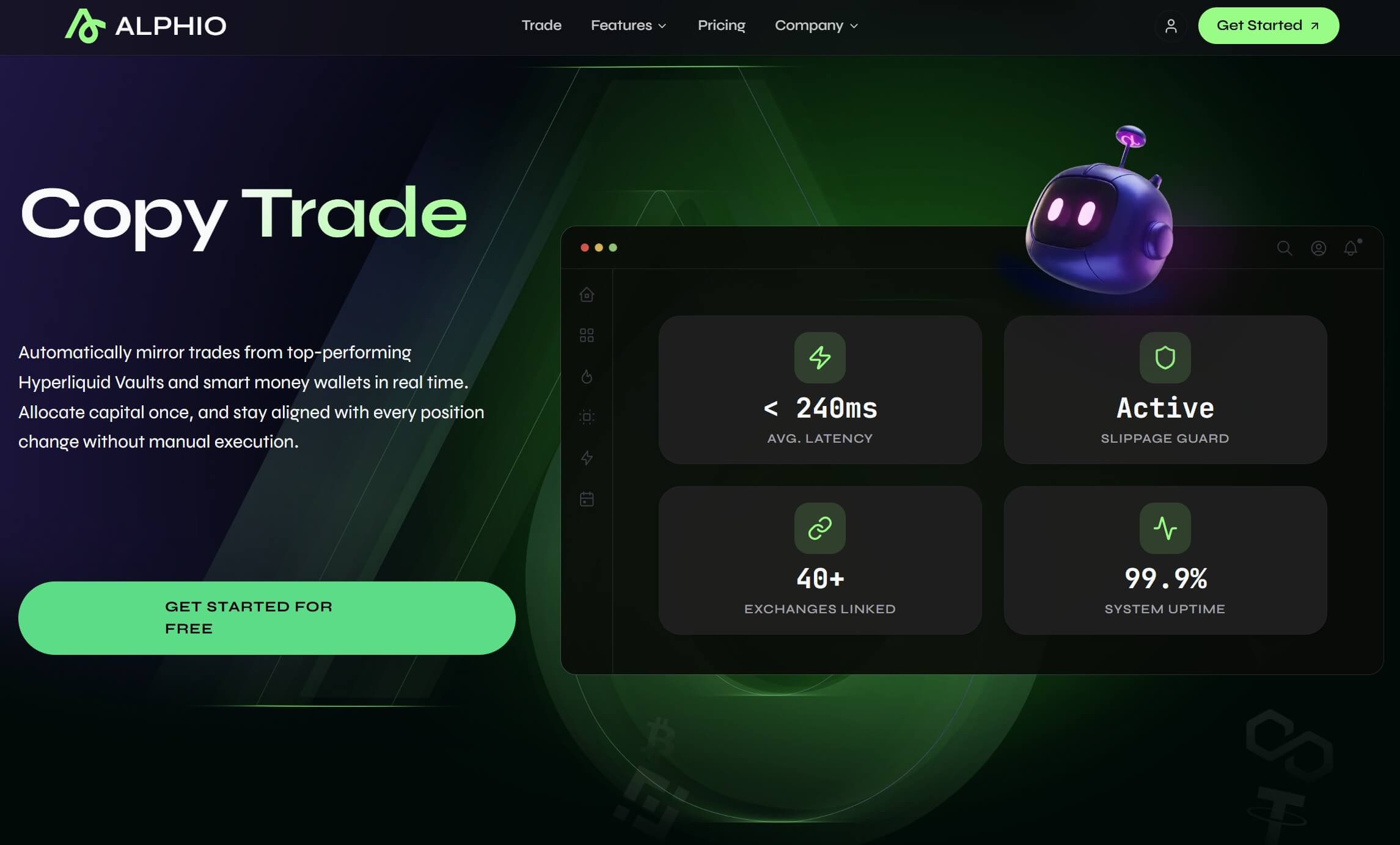
For investors seeking to mirror successful trading approaches, Alphio AI’s copy trading feature provides a seamless way to access proven strategies.
The platform supports copy trading across multiple asset classes including cryptocurrencies, stocks, and forex, with automatic position sizing and risk controls that protect copiers from excessive exposure to any single strategy.
Agentic Trading: The Next Evolution
Defining Agentic Trading
While copy trading replicates human decisions, agentic trading represents a quantum leap forward by deploying autonomous AI agents that can independently analyze markets, formulate strategies, and execute trades without direct human intervention for each decision. These AI agents are essentially digital traders that operate 24/7, processing information and making decisions faster than any human possibly could.
Agentic trading systems utilize sophisticated large language models combined with specialized financial AI architectures. They can read and interpret news articles, earnings reports, regulatory filings, and social media sentiment in real-time. More importantly, they can understand the nuanced relationships between different market events and predict how these events might impact various asset prices.
The autonomous nature of these agents means they can react to market opportunities instantly, executing trades within milliseconds of identifying favorable conditions. This speed advantage is particularly valuable in volatile markets where price movements can be substantial and rapid.
Benefits of Autonomous Trading
The primary advantage of agentic trading is the elimination of human limitations. AI agents do not experience fatigue, emotional bias, or cognitive overload. They can monitor thousands of market variables simultaneously and maintain consistent execution discipline regardless of market conditions.
Risk management is another area where agentic trading excels. These systems can implement complex portfolio hedging strategies, dynamically adjust position sizes based on volatility, and execute stop-loss orders with precision timing. The ability to process real-time risk metrics across an entire portfolio enables more sophisticated approaches to capital preservation than manual trading allows.
Furthermore, agentic trading democratizes access to advanced strategies. Sophisticated techniques like statistical arbitrage, momentum trading, and mean reversion can be deployed by investors with minimal technical expertise. The AI handles the complexity while the investor maintains control over high-level parameters and risk settings.
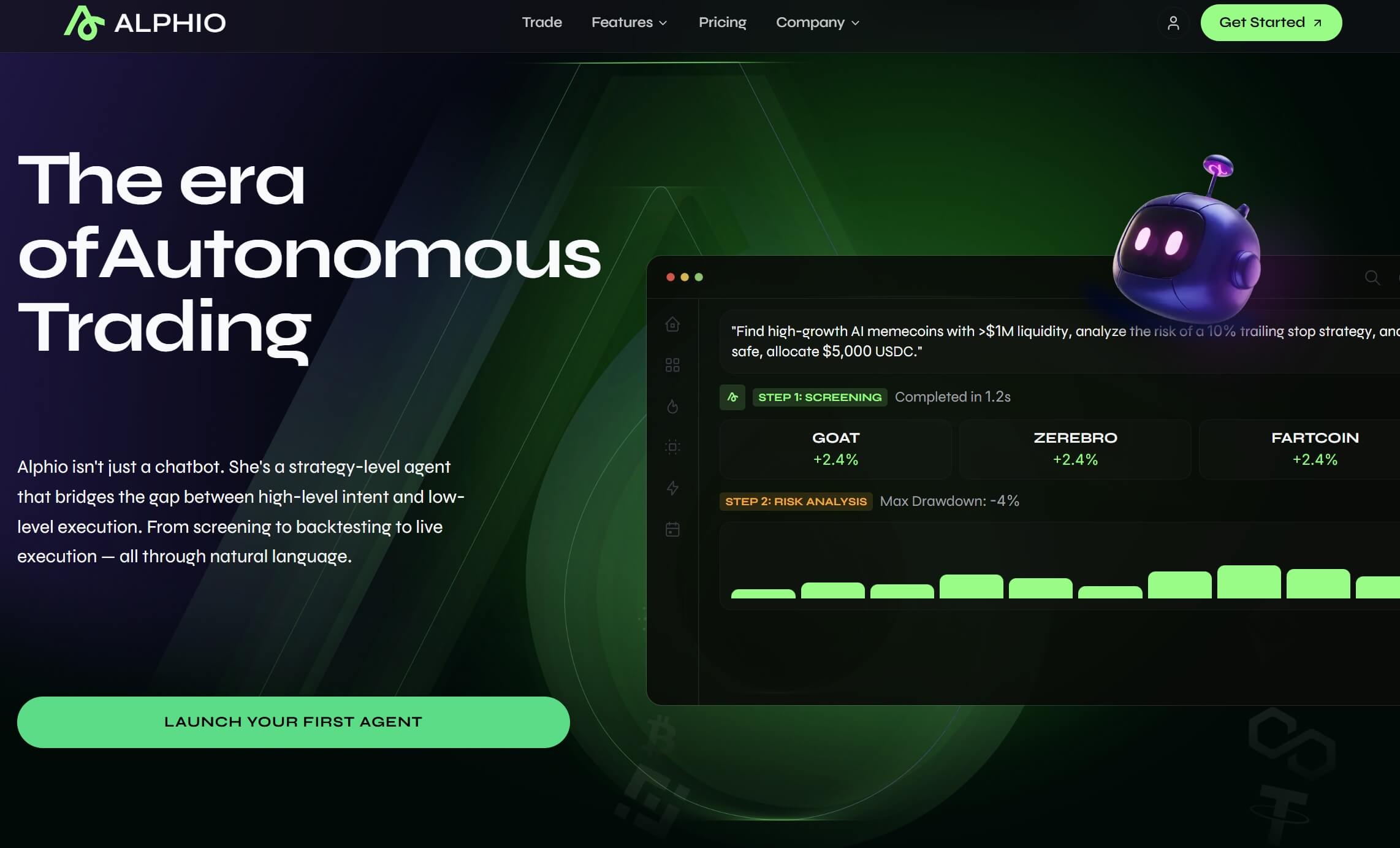
Alphio AI’s agentic trading capabilities allow investors to automate their portfolio management with AI-powered strategies that adapt to changing market conditions.
Automation and Scheduled Tasks
Building Conditional Workflows
Beyond copy trading and autonomous agents, modern AI trading platforms offer powerful automation tools that allow users to create custom trading workflows. These systems enable investors to set up conditional rules that trigger specific actions based on predefined market conditions or portfolio states.
For example, an investor might create an automation that automatically takes profits when a position gains 20%, simultaneously reallocating those gains to other positions based on current market momentum. Or they might set up alerts and automatic hedging strategies that activate when portfolio volatility exceeds certain thresholds.
The sophistication of these automation tools has increased dramatically. Today’s platforms support complex multi-step workflows with branching logic, time-based triggers, and integration with external data sources. This flexibility allows investors to implement highly personalized trading strategies that reflect their specific goals and risk preferences.
Scheduled Task Automation on Alphio
Alphio AI provides comprehensive automation capabilities through its scheduled task system. Users can create sophisticated trading automations that execute based on time schedules, price triggers, or portfolio conditions.
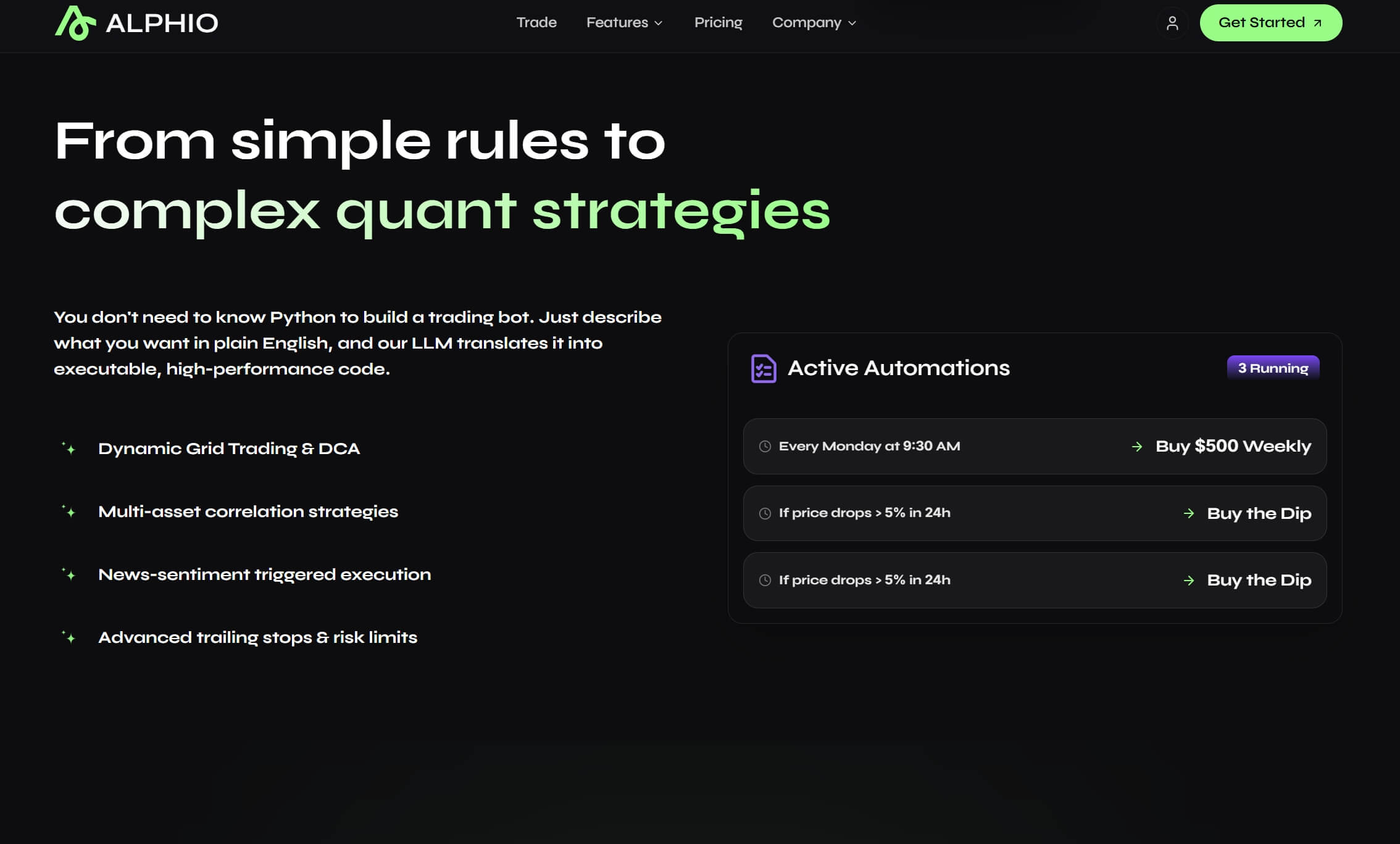
The platform’s visual workflow builder makes it accessible to non-technical users while still providing the depth needed by advanced traders. Common automation patterns include dollar-cost averaging strategies, rebalancing triggers, stop-loss management, and profit-taking rules. More advanced users can implement complex multi-asset strategies that respond to cross-market correlations and arbitrage opportunities.
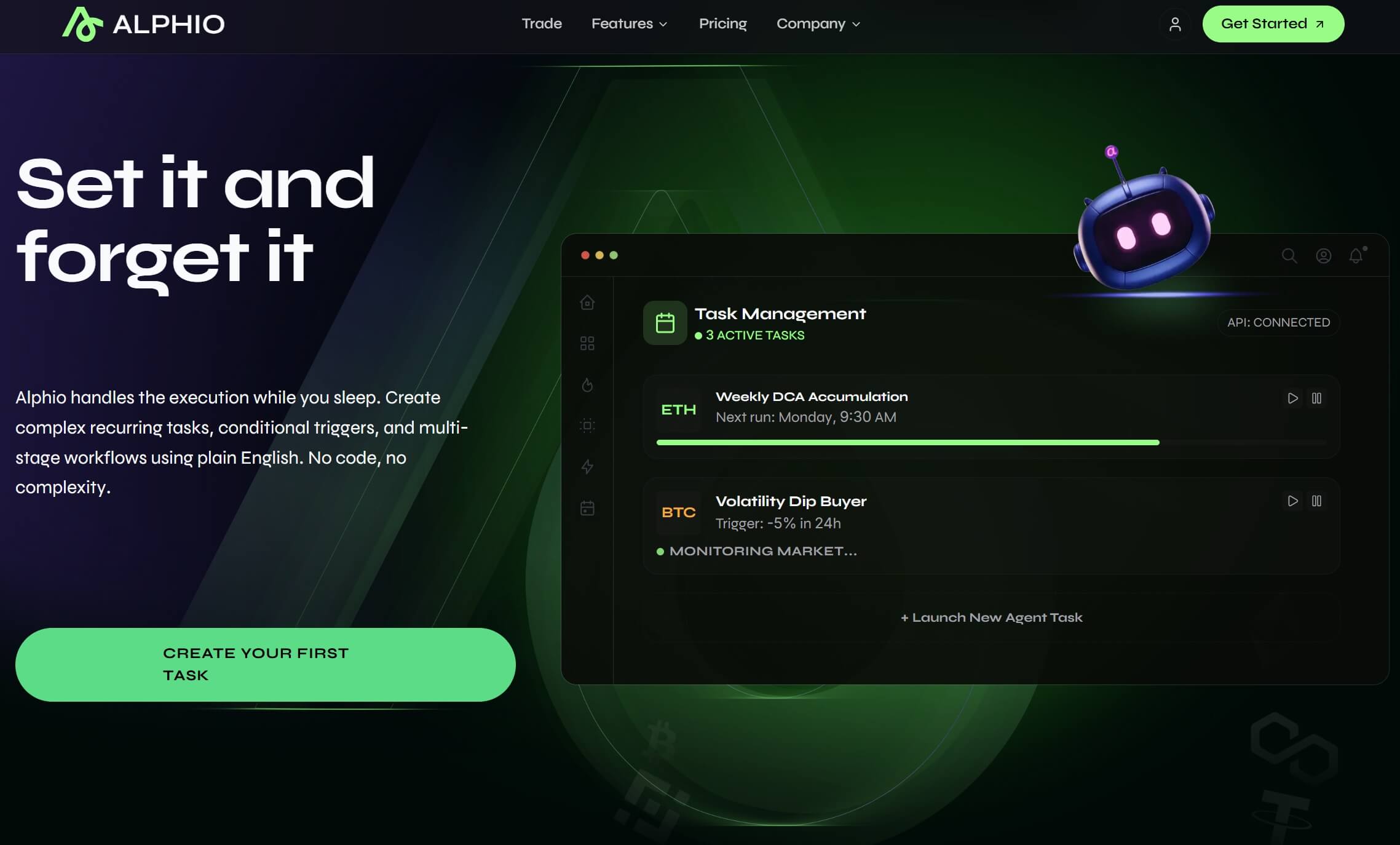
For investors looking to streamline their trading operations, Alphio AI’s automations feature enables the creation of conditional workflows that execute trades based on predefined rules and market conditions.
Conversational Trading Interfaces
Natural Language Trading
One of the most significant innovations in AI trading platforms is the emergence of conversational interfaces that allow users to execute trades and manage portfolios using natural language. Instead of navigating complex order entry screens and technical charts, investors can simply type or speak commands like “Buy $1000 of Bitcoin if it drops below $60,000” or “Show me my best performing positions this month.”
These conversational interfaces leverage large language models to understand user intent, translate natural language into precise trading instructions, and provide contextual feedback. The systems can handle ambiguity, ask clarifying questions when needed, and explain their actions in understandable terms.
The benefits extend beyond convenience. Conversational interfaces make trading more accessible to newcomers who might be intimidated by traditional trading platforms. They also enable experienced traders to execute complex strategies more efficiently, reducing the time and attention required for portfolio management.
Alphio’s Conversational Trading
Alphio AI has embraced conversational trading as a core feature, offering an interface where users can execute trades, set up automations, and analyze markets through chat-based interactions. The system understands complex trading commands and can execute multi-step strategies from simple natural language instructions.
The conversational interface also serves an educational purpose. New traders can ask questions about trading concepts, request explanations of market movements, and receive guidance on strategy development. This creates a more supportive onboarding experience compared to traditional platforms that leave users to figure things out on their own.
Investors can explore Alphio AI’s conversational trading capabilities to execute trades via chat and access AI-powered market insights.
Risk Management and Best Practices
Understanding the Risks
While AI trading automation offers compelling advantages, it is essential for investors to understand the associated risks. Automated systems can amplify both gains and losses, and the speed at which AI agents operate means that adverse market movements can impact positions rapidly.
One critical risk is over-reliance on historical performance. Strategies that performed well in past market conditions may not perform similarly in different environments. Market regimes change, and AI models trained on specific data distributions may struggle when conditions shift unexpectedly.
Technical risks also exist. API failures, connectivity issues, or platform outages can disrupt automated strategies at critical moments. Investors should maintain awareness of their automated positions and have contingency plans for potential technical problems.
Best Practices for AI Trading
Successful implementation of AI trading strategies requires thoughtful risk management. Investors should start with smaller position sizes while evaluating strategy performance, diversify across multiple uncorrelated strategies, and maintain manual oversight of automated systems.
Regular performance review is essential. Even well-performing strategies should be periodically reassessed to ensure they remain appropriate for current market conditions and personal financial goals. Investors should be prepared to deactivate or adjust strategies that show signs of degradation.
Education remains important. While AI handles the execution complexity, investors should understand the fundamental logic behind the strategies they deploy. This knowledge enables better decision-making when market conditions change or when evaluating new trading opportunities.
Conclusion
AI trading automation has fundamentally transformed the investment landscape in 2026. From copy trading that democratizes access to successful strategies, to agentic trading that deploys autonomous AI agents, to conversational interfaces that make complex trading accessible to everyone, the tools available to modern investors are unprecedented in their sophistication and ease of use.
Platforms like Alphio AI are at the forefront of this revolution, offering comprehensive suites of AI-powered trading tools that cater to investors at every experience level. Whether you are interested in mirroring successful traders through copy trading, deploying autonomous AI agents for portfolio management, or creating custom automation workflows, the technology now exists to implement these strategies with minimal technical barriers.
For investors ready to embrace the future of trading, Alphio AI provides multiple pathways to get started. Consider exploring the copy trading feature to mirror successful trading strategies, or dive into agentic trading to automate your portfolio management with AI-powered decision-making. The platform’s automation tools enable you to create conditional workflows tailored to your specific goals, while the conversational trading interface makes executing complex strategies as simple as having a conversation.
The future of investing is here, and it is powered by artificial intelligence. Those who adapt to this new paradigm will find themselves well-positioned to navigate the increasingly complex and fast-moving financial markets of tomorrow.