








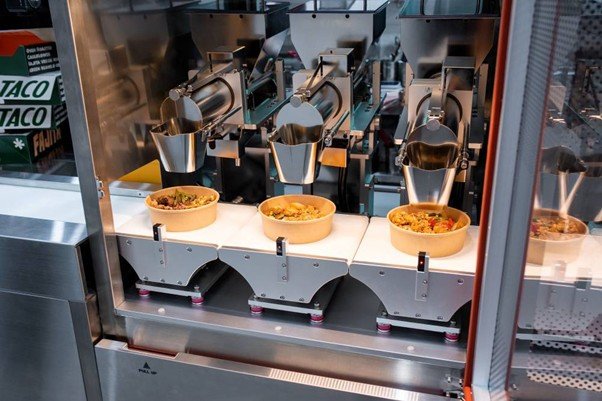
– The AI precisely measures and dispenses customizable, warm ingredients while tracking inventory. It also utilizes vision cameras, allowing franchise headquarters to monitor food quality and operations in real-time without on-site supervisors.
– Designed as a scalable, modular system with a rental cost similar to one worker’s monthly wage, RONIK aims to expand this automation model to other menus like rice bowls and fully unmanned stores.
There is only one employee in a 250-square-foot store near Noryangjin Station on the Seoul Subway. Even when delivery orders flood in during peak hours, what moves silently is not a human. It is the F&B store automation solution, AI Dispenser CUBE, developed by the startup RONIK.
When an order comes in through a kiosk or a delivery app, the AI Dispenser CUBE automatically dishes out the ingredients according to a set sequence and position. According to RONIK, a menu is completed approximately every 10 seconds, and multiple menus can be processed simultaneously. The average time it takes from order to final packaging is three minutes. The employee only needs to focus on packaging the completed menus.
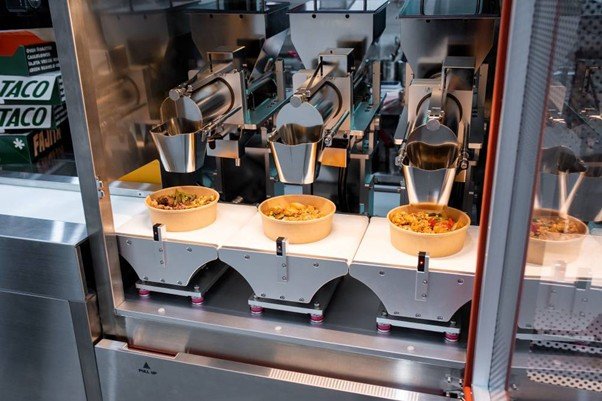
The RONIKAI Dispenser CUBE is completing a fajita menu for SEULTACO / Source=RONIK
This is the scene at the Noryangjin branch of SEULTACO FAJITA, a brand specializing in Mexican cuisine. Soft-opened last June, this store operates exclusively for takeout and delivery of fajitas, a type of taco. What differentiates it from existing SEULTACO stores is that the AI Dispenser CUBE completes the menus.
Expanding to Taco Menus Following Udon and Institutional Food Service
The reality of the self-employment market is not easy. With the overlapping rise in the minimum wage and labor shortages, the burden of labor costs grows every year, and even if people are hired, it is difficult to retain them for long. For food service stores with a high proportion of delivery and takeout, in particular, workforce management during peak hours translates directly into sales, yet stably securing that workforce is becoming increasingly difficult in itself.
The problem is that what humans handle in a food service store does not stop at just cooking. From taking orders, checking inventory, and ordering depleted ingredients, to consistently maintaining the taste and portion of the food. Operating a single store smoothly requires attention in many areas. RONIK did not narrow these tasks down to just cooking. They automated the various repetitive processes in the store individually, then linked them to operate in an interlocking manner, thereby separating the tasks that humans strictly must do from the tasks that machines can replace. The intent is to enable a single person to operate the entire store. This is where the statement from RONIK CEO OH JIN HWAN, “We do not sell robots. We sell businesses,” originates.
Having first verified the automation of the udon cooking process in 2025, RONIK states that it has accumulated technology to maintain precise measurement and uniform quality even in high-volume cooking after expanding its reach to institutional food service sites. SEULTACO FAJITA is the first instance of this technology being applied to a food service brand.
SEULTACO operates three existing stores. The Noryangjin branch of SEULTACO FAJITA is a new type of store specialized in takeout and delivery. The menu also newly introduced fajitas, which are unavailable at other stores. Fajitas are a dish where grilled vegetables and meat are directly wrapped and eaten in a warm tortilla. The decision was reportedly driven by the judgment that the ingredient preparation and presentation of fajitas make it an ideal menu to integrate with the AI Dispenser CUBE.
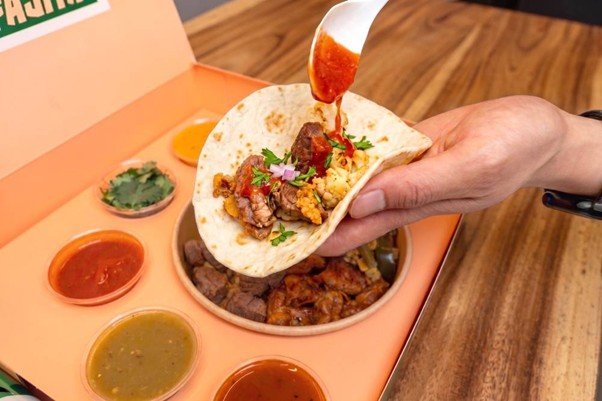
SEULTACO FAJITA menu / Source=RONIK
Instead of the method of ordering a set menu as is, the Noryangjin branch of SEULTACO FAJITA champions personalized ordering where customers manually select portions and ingredients to complete their dish. An order is finalized through six stages of selection. Customers first choose the portion size between ‘Basic’ and ‘Hearty,’ and select two types of grilled vegetables and meat each. Following this, they combine four out of twelve sauces. It is a structure where one directly composes a meal tailored to their appetite and taste, rather than ordering a fixed menu as is.
Backing this personalized ordering is the AI system inside the store, which in reality is divided into two pillars with different roles. SEULTACO FAJITA’s store management OS, MAEJANG HARU, analyzes customer reactions and menu sales trends based on order and review data to support digital marketing and store operations. The AI Dispenser CUBE measures vegetables and meat by weight according to the combination chosen by the customer and manages the storage temperature and inventory for each ingredient. Predicting the timing of ingredient depletion using accumulated usage data to assist with preparation and ordering, and reducing over-preparation or waste, is also the role of this combination, according to the explanation from RONIK.
LEE YONG HYUN, CEO of SEULTACO FAJITA, said, “It is important to simultaneously provide customers with the fun of selecting a menu to their taste and the experience of feeling consistent taste and freshness no matter when they order.” He added, “We have structured the store so that orders, marketing, and ingredient management are systematized through AI, allowing customers to focus on enjoying their very own Mexican meal.”
A recipe infused with the chef’s expertise
In this deployment, the key was how well the AI Dispenser CUBE could replicate the chef’s flavor. The main chef of SEULTACO FAJITA is an expert in Mexican cuisine, and due to the brand’s nature of prioritizing culinary perfection, RONIK explains that they also focused heavily on materializing this taste to the fullest extent. Unlike the conventional wisdom that ‘if a robot makes it, it is cheap,’ the differentiating point emphasized by RONIK is that the AI Dispenser CUBE in this store is integrated under a collaborative robot concept, taking on the role of elevating quality.
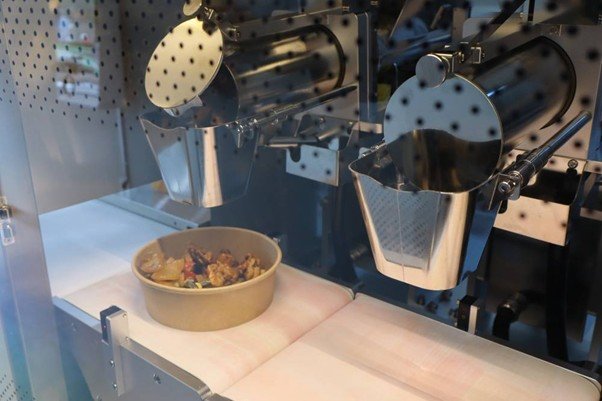
RONIK designed the AI Dispenser CUBE to store ingredients warmly, tailored for SEULTACO / Source=IT DongA
Tacos are a menu where not only the exact quantity but also the presentation is important. RONIK explains that they solved this problem by designing the landing positions in the container differently for each ingredient. CEO OH JIN HWAN stated, “At the request of SEULTACO FAJITA, we designed it so that ingredients can be stored warmly inside the dispenser cube. It is possible to maintain freshness by setting the optimal temperature differently for each ingredient.” He continued, “The equipment can be easily disassembled and assembled, so it can even be washed in a dishwasher.”
CHOI JONG CHAN, the store manager of the Noryangjin branch of SEULTACO FAJITA, said, “Since the introduction of the AI Dispenser CUBE, the time to make a single menu has decreased from an average of over five minutes to under two minutes.” He added, “It was awkward at first, but it becomes more comfortable the more we use it, and it definitely helps during peak hours.” The ingredient management method has also changed. He explained, “There is a process of refilling ingredients, but because the AI predicts how many bowls can be made with the remaining ingredients, this can also be prepared in advance.” It has effectively shifted from a method of guessing inventory by feel every time to a method of preparing by looking at data.
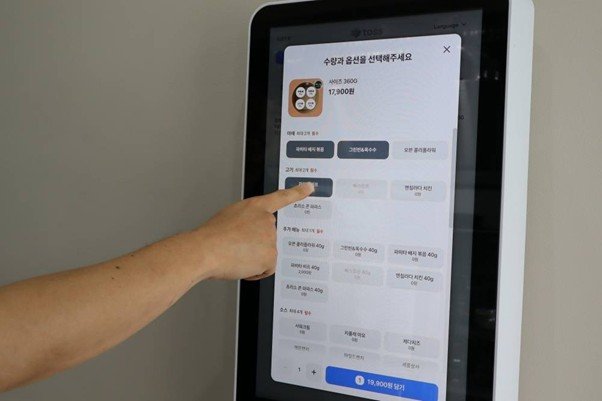
The kiosk and the AI Dispenser CUBE are linked, starting the cooking process immediately upon order / Source=IT DongA
The reactions from customers who have experienced the Noryangjin branch are also quite positive. One delivery review left a comment saying, “When you order through the kiosk, a robot makes it, which is fascinating, and I liked that it came out quickly.” RONIK explains that most customers do not particularly consciously register the existence of the AI Dispenser CUBE and tend to accept it as a natural piece of kitchen equipment. Of course, for some customers who have directly watched the AI Dispenser CUBE’s food-making process, this itself acts as an element of interest. In actual reviews, there were many responses highly praising the freshness and portion of the ingredients, cost-effectiveness, and friendly service.
Head Office Can Monitor in Real-Time… Quality Control Even Without an SV
A feature worth noting from the perspective of a franchise head office is the monitoring system. According to RONIK, the AI Dispenser CUBE collects mechanical parameters in real-time, such as motor load occurring during the measurement process, weight figures, and sensor collection values. The explanation is that if the measurement value of a specific ingredient is recorded higher than usual, it judges that clumping has occurred and automatically performs an agitating motion, creating a structure where precision increases as this process is accumulated as learning data.
The completed menu is filmed with a vision camera, which reportedly automatically determines the presence of foreign substances and whether it matches the order details. CEO OH JIN HWAN stated, “This data can be checked in real-time on the head office dashboard. Even without a supervisor (SV) visiting the store in person, it is possible to detect quality abnormalities or utilize it as evidentiary data when a customer complaint occurs.”
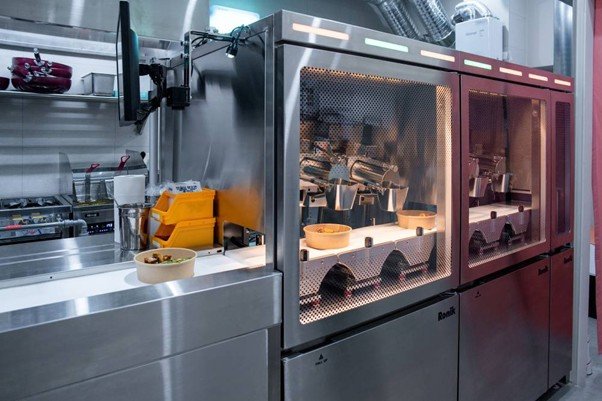
The AI Dispenser CUBE has a modular structure, allowing it to be adjusted according to the store type / Source=RONIK
RONIK emphasizes that the burden is not heavy in terms of economics either. The rental cost for the AI Dispenser CUBE averages around 2.5 million KRW per month, which they explain is equivalent to the labor cost of one employee. Because it is a modular structure, the rental fee is adjusted according to functional units and the number of units, and the deployment method can be selected from three options: lump-sum payment, rental, or revenue-linked share.
Established in 2022, RONIK initially started its business with modular cooking robots. According to RONIK, through udon stores and institutional food service sites, it accumulated hardware stability and AI learning data together. During this process, they realigned from modular cooking robots to the AI Dispenser CUBE.
However, the Noryangjin branch of SEULTACO FAJITA is not yet at a stage where stabilization is complete. According to RONIK, a new store typically goes through fine-tuning while accumulating data for about a month, and the Noryangjin branch is also currently going through this process. RONIK explains that as stores increase and data builds up in the future, the stabilization period will become shorter.
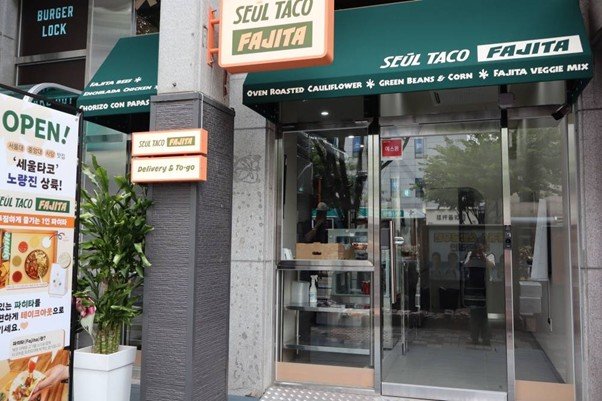
Exterior of the SEULTACO FAJITA Noryangjin branch / Source=IT DongA
In parallel with the stabilization of the Noryangjin branch, RONIK is already preparing its next references. They are planning for rice bowls (deopbap), soup with rice (gukbap), and even unmanned stores. RONIK forecasts that once the know-how accumulated in udon and institutional food service is combined with the food service brand application experience verified with tacos, the stabilization period for new stores will be significantly shortened.
The big picture envisioned by RONIK goes further from here. Their blueprint is to integrate order, inventory, preference, and time-specific sales data collected at the store into the head office dashboard, and based on this, connect to pilot operations of new brands, location recommendations through commercial district analysis, and the automation of inventory and ordering. By touting the fact that a new brand can be immediately pilot-operated by simply changing ingredients, recipes, and unit combinations on the same equipment, their strategy is to differentiate themselves from competitors by moving towards automating the entire store space rather than a single cooking process.
According to RONIK, because the AI Dispenser CUBE can handle most of the food service franchise menu categories, there are also relatively few constraints on industry expansion. Attention is drawn to what changes the trajectory of RONIK, which solidified its technological foundation with udon and institutional food service and set out for food service brand verification with SEULTACO, will bring to the F&B automation market.
By Kui-im Park (luckyim@itdonga.com)