









Demystifying Artificial Intelligence (AI)
🧠 1. What Exactly is AI?
At its core, Artificial Intelligence is a broad field of computer science dedicated to solving problems commonly associated with human intelligence. This includes core capabilities like:
– Perception & Reasoning
– Learning & Problem-Solving
– Decision-Making
🔍 2. The AI Hierarchy (The Nested Subsets)
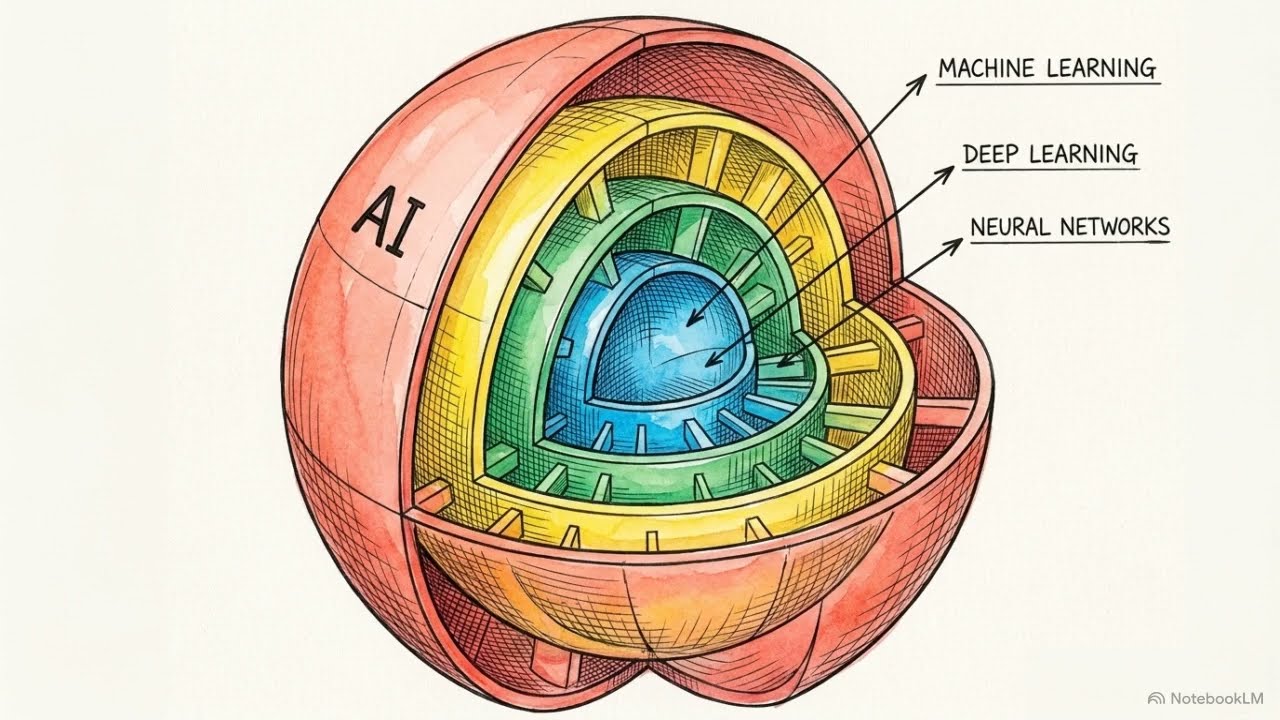
Many people use “AI” and “Machine Learning” interchangeably, but they are actually nested layers:
– Artificial Intelligence: The broad, outermost umbrella encompassing everything from rule-based systems to advanced neural networks.
– Machine Learning (ML): A subset of AI focused on training algorithms to learn patterns and make predictions from data—without being explicitly programmed with fixed rules.
– Deep Learning (DL): A subset of ML that uses multi-layered artificial neural networks (modeled after the human brain) to process highly complex patterns in unstructured data.
– Generative AI: Sits at the very center as a subset of Deep Learning. Instead of just predicting or classifying, it creates entirely new text, images, audio, or video based on statistical patterns.
🍎 3. How Does an AI Model Actually Learn?
Think of image classification. A data scientist feeds a categorized training dataset (like photos of apples, peaches, and bananas) into a classification algorithm. Once trained, the model enters the inference phase, where a user can upload a completely new, unseen picture and get an accurate prediction back.
In the business world, this plays out in highly practical tools like Intelligent Document Processing (IDP). IDP uses Computer Vision, Deep Learning, and NLP to automatically read scanned invoices, extract key information, and write it directly to a database.
⏳ 4. A Quick History Check
AI didn’t appear overnight! Its timeline is fascinating:
1950s: The official birth of AI, marked by Alan Turing’s Turing Test and John McCarthy officially coining the term.
1970s: The era of rule-based Expert Systems like MYCIN, which used over 500 rules to identify bacteria.
1997: IBM’s Deep Blue defeats world chess champion Garry Kasparov.
2016: Google’s AlphaGo defeats Go champion Lee Sedol.
2020s: AI integrates into everyday life (virtual assistants, autonomous vehicles), sparking critical discussions on ethics and regulations.
#ArtificialIntelligence #MachineLearning #GenerativeAI #AWS #CloudComputing #TechEducation
source