









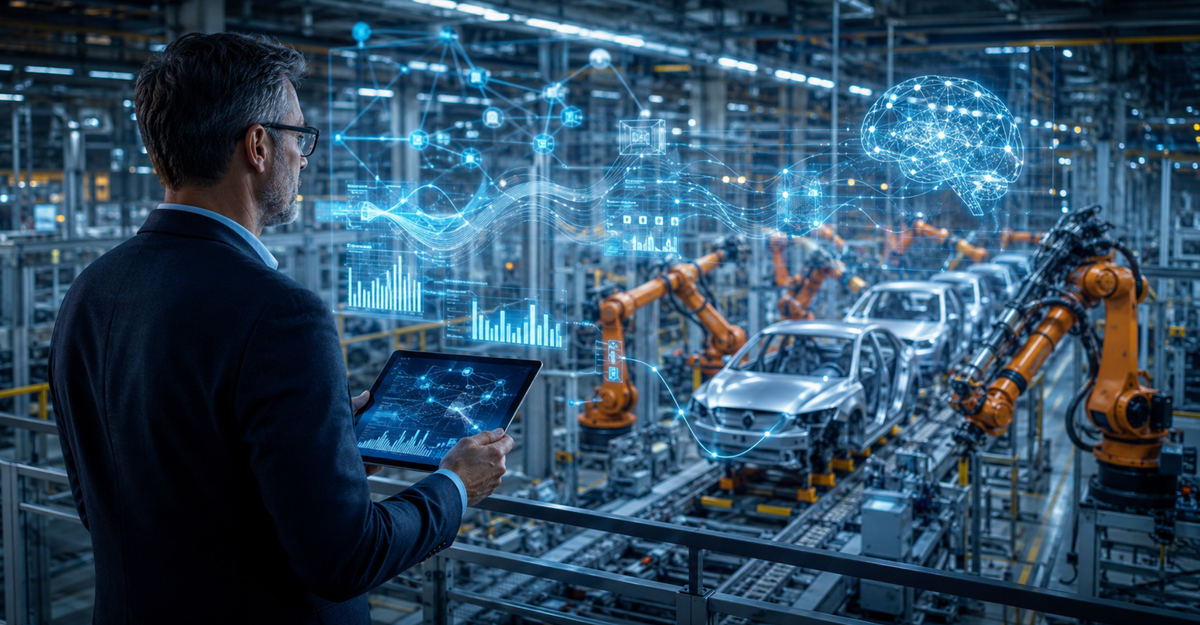
If you walk into the control room of a modern Tier-1 auto components manufacturer, you likely will not see piles of spreadsheets anymore. You will see massive screens displaying SAP HANA dashboards, Oracle Demantra forecasts, and SAP Ariba supplier portals.
Many supply chain leaders believe that because they have implemented these heavy-hitting enterprise systems, they have achieved “digital transformation”. But there is a hidden trap: automation is not intelligence.
Let us look at a “typical day” at NexGear Auto Systems. It has top-tier enterprise resource planning (ERP) and advanced planning systems (APS). But let us see what happens when volatility hits, and why transitioning from automated to agentic AI is the real game-changer.
The automated but rigid reality: the exception management trap
The trigger: Tuesday, 09:00. A major original equipment manufacturer (OEM) customer sends an automated Electronic Data Interchange (EDI) 830 Planning Schedule directly into NexGear’s SAP HANA system. It needs a 20% increase in sensor clusters for next month and is delaying its sedan wiring harnesses due to low demand.
The automated process and its flaws:
- Vikram, VP of Sales: The EDI flows seamlessly into the system. Oracle Demantra updates the statistical forecast. The flaw? Demantra relies on historical data and rigid algorithms. It updates the numbers, but it does not understand the context of why the OEM changed the order, nor can it negotiate the shift.
- Ananya, Head of Supply Chain:
- The work: At 02:00 on Wednesday, the SAP system runs its massive overnight Material Requirements Planning (MRP) batch job.
- The reality: When Ananya logs in on Wednesday morning, she does not have a solution; she has a dashboard blinking with 450 red “exception alerts”.
- The delay: SAP Ariba automatically sent updated purchase orders (POs) to the Tier-2 suppliers through the supplier portal. However, the microchip supplier rejected the sudden 20% increase due to a shortage. The system simply flagged this as a “stockout risk”. Ananya now has to spend the next 48 hours manually calling suppliers, expediting freight, and overriding system parameters.
- Rahul, Plant Manager: His scheduling module flags a capacity constraint. The system just says “overload”. Rahul still has to pull his supervisors into a room to manually determine how to resequence the machines.
The result: The system processed the data faster than a spreadsheet, but the heavy lifting of decision-making and problem-solving still fell entirely on human shoulders. The ERP is a system of record; it is not a system of intelligence and action.
The paradigm shift: the agentic AI layer
Now, let us inject a workforce of digital workers, or agentic AI, into NexGear’s existing technology stack. The AI does not replace SAP or Oracle; it sits on top of them as a “system of intelligence”, acting as the ultimate orchestrator.
Here is that exact same Tuesday morning, supercharged by agentic AI:
The trigger: Tuesday, 09:00. The OEM customer sends the EDI into SAP.
The autonomous resolution:
- 09:01: The market intelligence agent for demand
- The agent intercepts the EDI. Instead of waiting for Demantra’s batch run, it instantly validates the change against external unstructured data, such as market news about surging SUV sales. It automatically updates the demand signal in SAP HANA in real time.
- 09:03: The supply risk agent
- The agent does not wait for the overnight MRP run. It instantly simulates the bill of materials explosion. It proactively queries the SAP Ariba supplier portal network.
- It sees that the primary microchip supplier has rejected the 20% surge. Instead of just flashing a red alert on Ananya’s dashboard, the AI acts. It autonomously scans the Ariba network for secondary, pre-approved suppliers with available inventory. Here, the AI agent mimics human intelligence and, therefore, works autonomously to find the next-best alternative supplier.
- 09:05: The balancing orchestrator
- The AI calculates that buying from Supplier B incurs a 4% material cost premium but prevents an OEM line stoppage.
- The action: Without human intervention, the AI drafts the new PO, routes it through SAP Ariba, obtains Supplier B’s confirmation through the portal, and updates the inbound logistics tracking.
- It then updates Rahul’s factory scheduling module with a dynamically optimised sequence that minimises changeover times.
The human-in-the-loop action
- 09:10: Ananya logs in. Instead of 450 red alerts, she sees a clean dashboard. The AI presents a summary: “OEM demand shifted. Microchip shortfall resolved through Supplier B at a 4% premium, within your 5% approved guardrails. System updated.”
- The AI then escalates one high-level strategic issue: “Supplier B is located near a port facing potential labour strikes next week. Do you want me to split the order and use air freight to mitigate the risk?” Ananya clicks “Yes”, and the AI executes the complex split shipment in SAP.
The true value of AI in an automated enterprise
If you already have SAP, Oracle, and Ariba, agentic AI is the bridge that takes you from merely recording supply chain events to autonomously resolving them.
- Eradicating exception fatigue: Human planners stop acting as “ERP babysitters”, clearing hundreds of low-level alerts, which frees them to handle complex, strategic supplier relationships.
- Continuous versus batch planning: Moving away from rigid, overnight MRP runs to real-time, continuous demand-supply synchronisation.
- Smarter ROI on existing technology: AI maximises the significant investments already made in ERPs by finally utilising data lakes to execute autonomous decisions.
In the modern auto components industry, the winner is not the company with the most data in its ERP. It is the company whose systems can think, balance, and act on that data before the competition even finishes its morning coffee.
The rise of digital workers: institutionalising AI agents in SCM
AI agents mimic human intelligence across various operational roles by utilising cognitive abilities such as perception, reasoning, planning, execution, reflection, adaptation, metacognition, and memory. Because of these advanced capabilities, AI agents function as “digital workers”, capable of executing complex tasks traditionally performed by people in roles such as demand planners or supply chain managers.
Therefore, organisations must begin initiating proofs of concept (PoCs) to develop their own strategic playbooks, allowing them to successfully institutionalise digital workers throughout the broader supply chain management (SCM) ecosystem.
However, integrating AI agents into an existing SCM ecosystem is a complex undertaking that requires robust change management. It necessitates a significant shift in human roles and responsibilities to effectively supervise and co-ordinate with these digital counterparts.
Furthermore, strict governance is essential: AI agents must be observable; their decision-making outputs must be explainable; and they must strictly safeguard data security and privacy. Finally, robust business continuity measures must be established to mitigate risks and maintain operations in the event of unexpected algorithmic errors or system failures.
——
By V. Srinivasa Rao (VSR)
Chief Digital and Agentic AI Advisor and Consultant
Former Chief Digital Officer, Tech Mahindra
(Disclaimer: The views expressed in this article are those of the authors and do not necessarily reflect the views or editorial position of Dataquest or CyberMedia.)