







💼 Business owner or operator with a team? We build AI automation systems that cut costs and scale ops — done for you: https://ryanandmattdatascience.com/ai-consultant/
🚀 Want to make money with AI skills? Join our free community — real projects, real client strategies, and the exact stack we use: https://www.skool.com/data-and-ai
🍿 WATCH NEXT
n8n Playlist: https://www.youtube.com/watch?v=MYsr7EIbDG0&list=PLcQVY5V2UY4K0mpuJ-oYO_LI25w5VDUD5
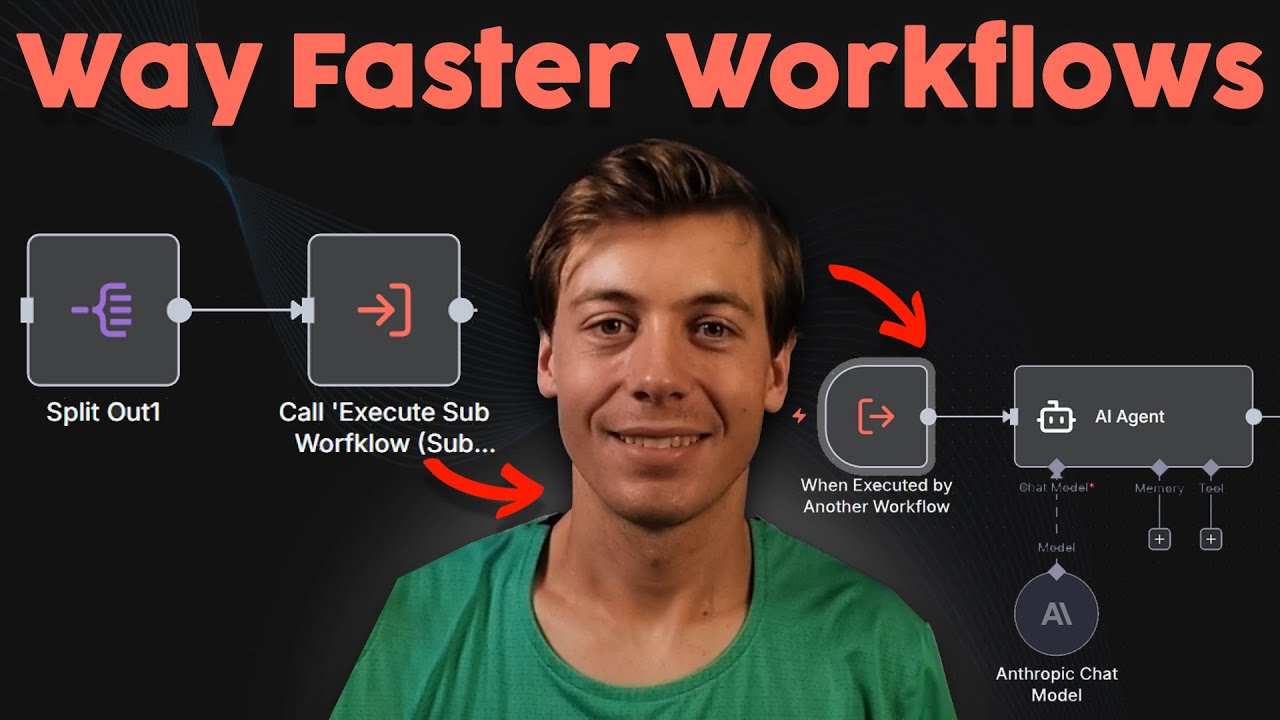
Learn how to use N8N’s execute subworkflow trigger and node to build modular, efficient AI automation workflows. This comprehensive tutorial covers everything from basic subworkflow setup to advanced parallel processing techniques that can dramatically speed up your N8N workflows.
In this video, I walk through six real-world examples showing why execute subworkflow is essential for professional N8N development. You’ll discover how to reuse logic across multiple workflows, break down complex 100+ node workflows into manageable pieces, and improve maintenance by centralizing repeated operations. I also demonstrate parallel processing techniques that can cut execution time in half, plus show you the quick shortcut for converting existing nodes into subworkflows with just a right-click.
We cover critical use cases including webhook validation workflows, AI guardrails for PII detection and prompt injection prevention, and best practices for managing rate limits when processing multiple items. Whether you’re building chatbots, automating business processes, or creating complex AI agent systems, understanding subworkflows will level up your N8N skills and help you build cleaner, faster, more maintainable automations that scale.
TIMESTAMPS
00:00 Introduction to Execute Subworkflow
01:03 Five Key Concepts for Using Subworkflows
02:08 Breaking Down Complex Workflows
03:27 Setting Up Execute Subworkflow Node
05:17 Basic MVP Example Walkthrough
06:40 Understanding Workflow Inputs
09:10 Running Your First Subworkflow
10:42 Example 2: Handling Multiple Items
12:32 Run Once vs Run For Each Item
14:02 Converting Nodes to Subworkflows Shortcut
14:53 Example 4: Web Hooks and Subworkflows
16:02 Example 5: Guardrails Use Case
17:22 Parallel Processing Explained
20:00 Video Recap and Best Practices
OTHER SOCIALS:
Ryan’s LinkedIn: https://www.linkedin.com/in/ryan-p-nolan/
Matt’s LinkedIn: https://www.linkedin.com/in/matt-payne-ceo/
Twitter/X: https://x.com/RyanMattDS
*This is an affiliate program. We receive a small portion of the final sale at no extra cost to you.
source