









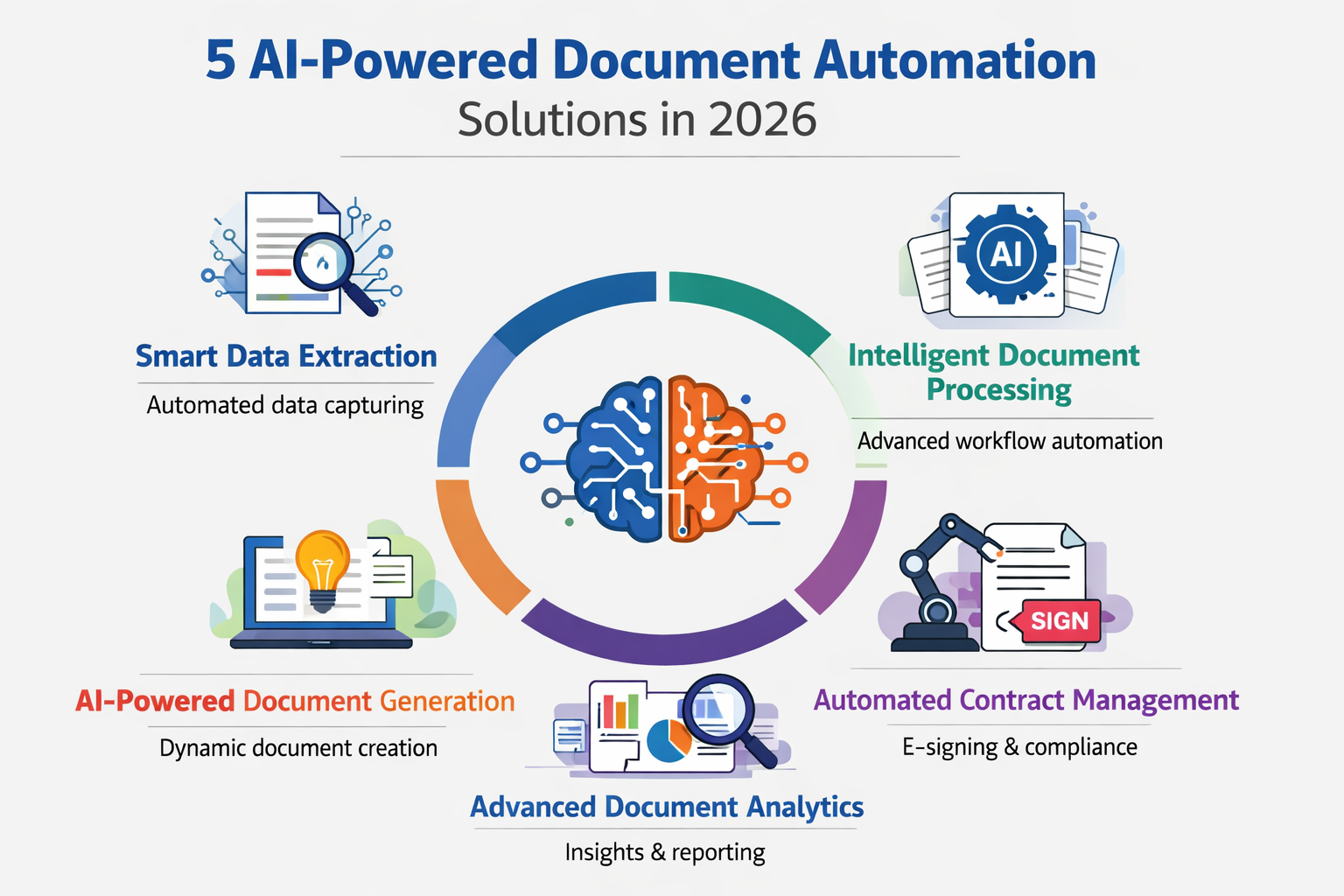
In today’s corporate landscape, businesses need intelligent systems that can process data without constant human intervention. AI, particularly through AI OCR, is crucial for document automation, allowing software to go beyond simple scanning. Purpose-built AI understands a document’s content, verifies its accuracy, and can even communicate with customers. By combining sophisticated document automation with large language models (LLMs), businesses can drive higher accuracy and create measurable value.
According to Gartner, “by 2026, over 80% of enterprises will have used generative AI APIs or models, and/or deployed GenAI-enabled applications in production environments.” By reading this guide, you will discover the five solutions leading the market and learn how to transform heavy administrative burdens into efficient, digital workflows that improve accuracy and reduce operational costs.
1. ABBYY Flexicapture
ABBYY FlexiCapture is a powerful document automation platform featuring purpose-built AI designed to transform business documents into actionable value. By combining natural language processing (NLP) and machine learning, it provides a single, enterprise-scale solution for capturing, classifying, and extracting data from any source, structured or unstructured. FlexiCapture enables global organizations to achieve “touchless” processing and faster onboarding while significantly lowering operating costs and manual errors.
Whether deployed in the cloud or on-premises, it integrates seamlessly with existing systems. With continuous machine learning, the system evolves with your business, reducing verification time and providing full visibility into process performance. Scale your operations and ensure end-to-end compliance with the market’s most accurate intelligent capture engine.
Reference from: https://www.abbyy.com/flexicapture/
2. Docsumo
Docsumo has shifted from just being an extraction tool to becoming an Agentic platform. In 2026, their main aim is to achieve autonomy in decision-making. Instead of just extracting information from a financial statement, Docsumo’s AI agents can think through a file. For instance, in case a bank statement contains unusual transactions, the AI agent will be able to identify it as a risk without having to first examine it.
Docsumo’s strength lies in Cross-Document Validation. If you upload 10 different documents for a loan application, Docsumo will automatically check whether the address on the utility bill matches the address on the identification document and the tax return document. This is document automation, and it helps reduce the time-to-decision from hours to less than five minutes, making it a favorite for new-age lending and insurance companies.
3. Klippa DocHorizon
Klippa has carved out a niche in 2026 as the most secure and mobile-friendly option for AI OCR. While other tools focus on office work, Klippa is designed for the field. Their DocHorizon platform is widely used by logistics and retail companies to scan price tags, utility meters, and delivery notes using only a smartphone.
The standout feature this year is their advanced Fraud Detection suite. Klippa’s AI can now detect digital footprints left by photo-editing software. If a customer tries to submit a fake receipt or an altered ID, Klippa identifies the pixels that were changed. It also offers Data Anonymization, allowing companies to process documents while automatically hiding names and photos to protect user identity.
4. UiPath Document Understanding
UiPath remains the king of End-to-End automation. Their 2026 update to the Document Understanding API (v2) introduces Taxonomy-Driven Extraction. This allows the AI to organize very complex, multi-page document packets (like a 100-page legal file) into logical Field Groups. This makes it much easier for humans to review only the parts that the AI is unsure about.
UiPath is the best choice for companies that have messy, unstructured data hidden in images or handwriting. Because it is part of a larger RPA (Robotic Process Automation) ecosystem, the data extracted doesn’t just sit there; it is instantly moved into your SAP or Oracle systems by digital robots. This creates a no-touch workflow where a document enters an email and is fully processed in the company’s main database seconds later.
5. OpenText Exstream
OpenText Exstream is the bridge between processing a document and talking back to the customer. In 2026, it has evolved into a Communication Powerhouse. While other tools focus on reading data (input), Exstream focuses on creating and delivering data (output). It uses Document Automation to take the facts found by an AI and turn them into beautiful, personalized letters, emails, or SMS alerts.
For large banks and utility companies, Exstream makes sure all communications are compliant with the law and the brand’s voice. Its new GenAI assistant helps employees write better letters by checking for clarity and tone. Exstream also works with Guidewire and SAP, so if a claim is approved by an AI, Exstream will instantly send a personalized settlement package to the customer’s phone with zero human interaction.
Concluding Remarks
The rapid pace of Document Automation in 2026 is clearly focused on two main aspects: intelligence and speed. We no longer want software that merely reads text; we need software that thinks, verifies, and talks. Is it the high-end security of Klippa, or is it the all-out robotization of UiPath? These five software solutions are helping the modern enterprise break free from drowning in paperwork and start moving at the speed of AI. Using these frameworks will ensure that you stay competitive, compliant, and relevant in the world of AI-powered work.