At Rivian’s (RIVN) Autonomy and AI Day on Dec. 11, the pure-play EV maker outlined a whole range of tech and software products, with a focus on vertical integration — meaning doing everything from end to end in-house.
CEO RJ Scaringe launched the company’s new Autonomy platform at the event — and during a trying time for the EV sector, in which so far only Tesla has achieved profitability. While Rivian has achieved gross profits in recent quarters, actual bottom-line (or net) profits have been elusive.
Scaringe, who founded the company in 2011, saw Rivian go public in 2021 and reach stratospheric heights of $120 a share before the stock came back down to earth, now at $18. A crucial cash infusion from Volkswagen (VWAGY) of nearly $6 billion via a joint venture between the two companies has given Rivian much-needed breathing room.
The following is a condensed version of Yahoo Finance’s conversation with Scaringe, touching on the company’s path toward full self-driving (FSD), or personal L4, as Rivian calls it, building in-house chips, and where the overall EV industry is headed.
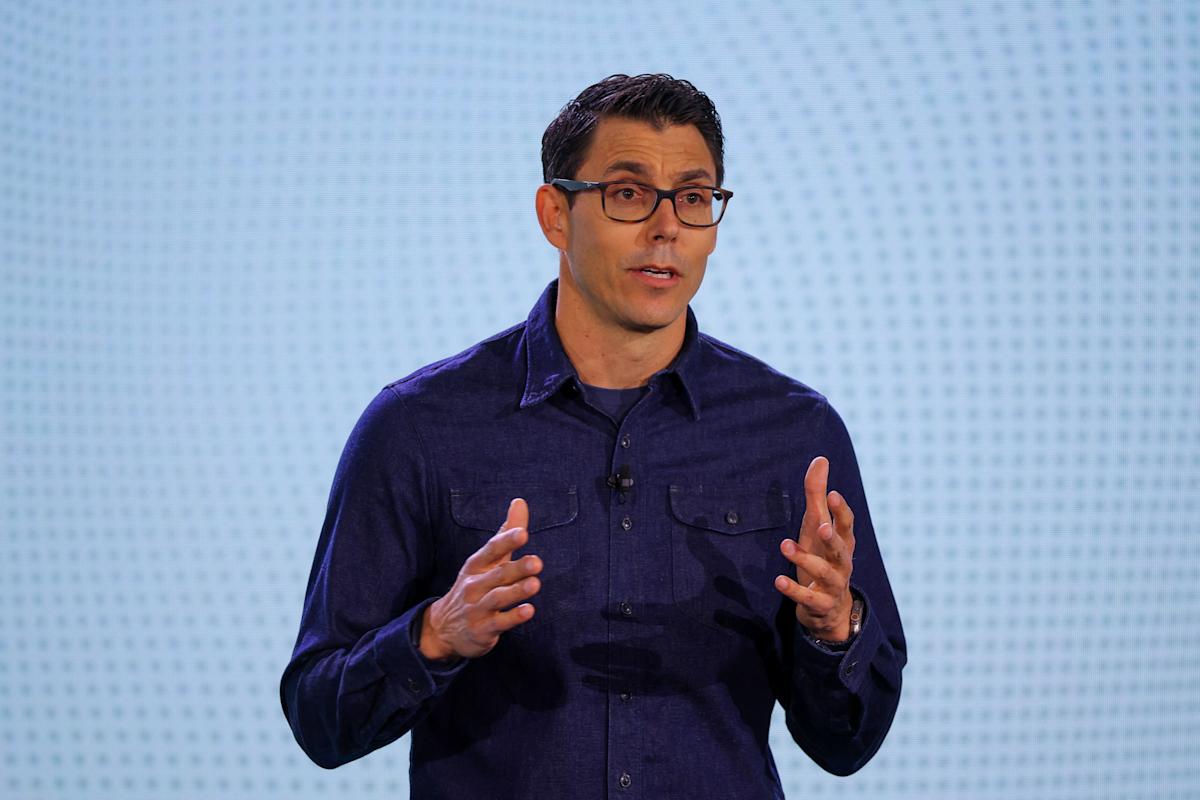
Rivian CEO RJ Scaringe speaks at the company’s first Autonomy and AI Day, showcasing developments in self-driving technology, in Palo Alto, Calif., on Dec. 11, 2025. (Reuters/Carlos Barria) ·REUTERS / Reuters
Yahoo Finance: Thanks for having us here, RJ. Rivian’s Autonomy platform — talk to me about the progression from where Rivian is right now to what’s going to come out in the near term and its vision for the future.
RJ Scaringe: Autonomy has been a journey for us. We followed the launch of our Gen 1 vehicles at the end of 2021. In early 2022, we realized we wanted to do a clean-sheet approach to our Autonomy platform. So we started the process on that, and that involved developing a camera platform, redesigning the compute platform, and architecting the whole system around an AI-centric approach.
That was what went into our [current] Gen 2 vehicles that we ultimately launched in the middle of 2024, and the compute relative to our Gen 1 [vehicles] increased by about 10x — that’s the inference on the vehicle. When we launched that, there was 55 megapixels of cameras, an array of radars, and that began the process of building the data stream to really train this model.
On our Gen 3 platform, it’s [built using] an in-house chip … This is a platform that can process 5 billion pixels per second, so that’s roughly 5x the best in class today. This is very, very high processing capability. And that not only raises the performance level of this platform, but it also allows us to build the model more efficiently and more quickly.
Rivian CEO RJ Scaringe speaks as a screen displays an image of Rivian’s autonomy processor at the company’s first Autonomy and AI Day, showcasing developments in self-driving technology, in Palo Alto, Calif., on Dec. 11, 2025. (Reuters/Carlos Barria) ·REUTERS / Reuters
Currently, Rivian offers Universal Hands-Free, which is akin to GM’s Supercruise, and that will be expanded to more roads. What comes next?
In 2026, we’ll add “point to point.” So you can get in the car from your driveway, type the address, and it does everything, hands-free, eyes-on, etc. … But it’s still supervised.
Then the platform expands to the next big step, which is eyes-off — and eyes-off is really powerful. That’s when you can start to be in the car, be on your phone, be reading a book. Essentially, your role in driving the car diminishes to nothing. You’re just a passenger.
And then the next step beyond that is what we call personal Level 4, which is the idea that the vehicle can completely operate on its own, even without anybody in the car. And so things like picking the kids up from school, an airport drop-off, or grabbing groceries.
You mentioned the custom silicon Rivian is making in-house. Talk to me about why that’s important for you to make that the next jump in the next few years. Why not use an off-the-shelf self-driving product like Nvidia’s?
We made the decision years and years ago to build our entire vertical software platform in-house and not rely on tier-one suppliers for any of that content … We then built teams of thousands of people to go put all that together. [We] spent many, many, many hundreds of millions of dollars to develop those systems. And when we’ve approached autonomy and our overall AI roadmap, we had a very similar view, which is this is going to be the most important technical shift in transportation, I would say, more than anything else, more than anything since the beginning of the car. And we wanted to control our own destiny…
You [also] need a partnership with someone like a TSMC, which in our case is our partner. [Although Rivian designed its chip in-house, a chipmaker is needed to actually produce the chip.] And what we’re going to get is better performance, something that’s very specific to vision-based robotics … And then we needed to build this data flywheel, and so lots of offline training, that means lots of GPUs.
The Rivian R2 equipped with the latest hardware and Rivian’s Autonomy platform software. ·Pras Subramanian
I want to mention Tesla because it is doing the same thing with regard to going fully vertical. It has its own chips. It’s doing its own data centers. But unlike Tesla, Rivian uses sensors as opposed to just camera vision. Do you think Rivian can meet, and even surpass, where Tesla FSD is in the next couple of years?
Our goal is to be world-class. Tesla, to be clear, is a great product. They’ve built a really impressive platform. We’re very much aligned with them on believing it needs to be a neural-net-based approach, building an end-to-end trained model that’s using a fleet of vehicles, building a data flywheel that trains the model with reinforcement learning. So we really agree here.
We do have a different view on the benefits of a diverse set of perception modalities. In our case, still being camera-heavy, call it camera-primary. But by including radar and lidar [light detection and ranging], it allows us to turn our entire fleet into a “ground truth” fleet. So every vehicle on the road is very helpful in training our model. [Similar to Tesla, Rivian’s EVs will send massive amounts of data collected via sensors and cameras to train its self-driving model.]
Rivian’s Universal Hands-Free assisted driving software in action. ·Rivian
I want to ask you about the bigger picture of the EV industry in America. The tax credit went away in Q4. How are things going for you now as a result? I’ve heard people talk about how the pure-play EV makers might actually benefit from this because we have fewer competitors in the market.
I think what you postulated in your question is probably somewhat right. I think you are seeing a lot of manufacturers pull back. I think that’s unfortunate. I think it’d be healthier for the auto industry if everybody was focused on electrification. I think that pullback means there’s going to be less choice, which is bad for customers. But I do think because there’s less choice, it means it’s going to be a less competitive environment…
If you were to look at the segment of vehicles with price points that start under $50,000, there’s very few highly compelling choices, and as a result of that, a single company, Tesla, has accumulated around 50% market share … and that’s not a reflection of a healthy industry. It’s a reflection of an underserved market. And so if we want to see electrification go from its 8% adoption, which is what it is in the United States today, to let’s say 25 or 30 or ultimately 100%, we need to have more than one great choice.
And of course, I think Rivian is one of those [great choices] with our R2. I think it’s going to be exceptional. The car itself is just amazing, but I hope there’s others.
StockStory aims to help individual investors beat the market.
Pras Subramanian is Lead Auto Reporter for Yahoo Finance. You can follow him on X and on Instagram.